
12 Common Mistakes to Avoid in a Personal Injury Claim in Arizona
Being injured in an unexpected accident, whether a highway collision, a slip on unsafe property, or a sudden dog attack, can throw your life into immediate turmoil. Beyond physical pain and emotional trauma, you’re suddenly faced with mounting medical bills, lost paychecks, and aggressive insurance adjusters.
What many accident victims don’t realize is that the days immediately following an injury are a legal minefield. A single offhand remark, a delayed doctor’s appointment, or a missed deadline can give insurance companies the exact leverage they need to deny your claim or dramatically lower your settlement payout.
Protecting your rights requires knowing what not to do just as much as taking the right legal steps.
In this article, we’ll walk you through the 12 most common mistakes to avoid in a personal injury claim in Arizona.
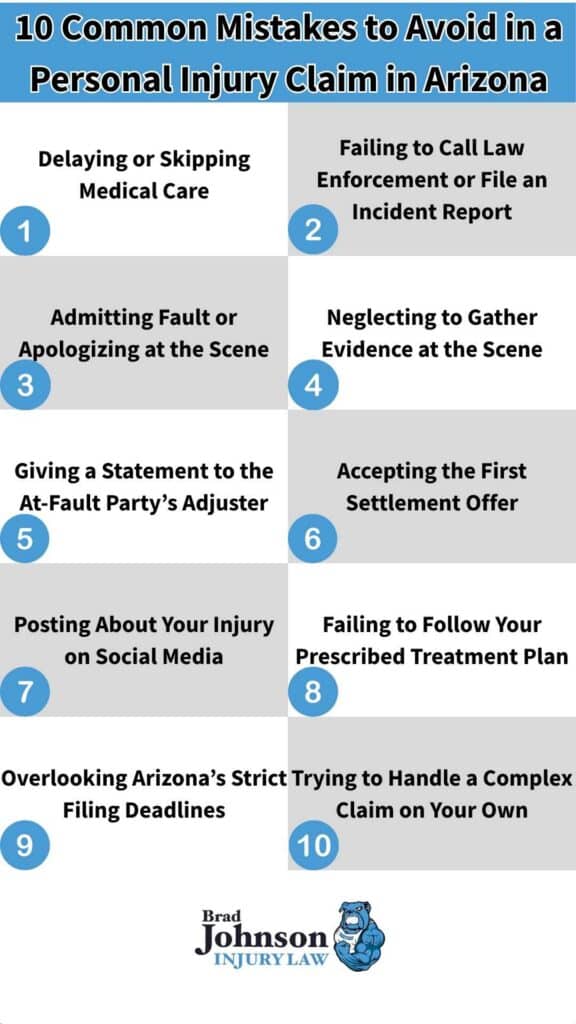
The 12 Most Common Mistakes to Avoid in a Personal Injury Claim
1. Delaying or Skipping Immediate Medical Attention
After an accident, adrenaline often masks severe pain or underlying internal injuries. Skipping a medical evaluation (or even waiting too long to see a physician) is one of the most frequent reasons insurance adjusters deny claims.
Insurers will argue that your injuries were either not serious or caused by a separate, unrelated event.
Seeking immediate care creates an official medical paper trail linking your injuries directly to the incident.
2. Failing to Call Law Enforcement or File an Incident Report
Whether you’re involved in a multivehicle collision on the Loop 101 or a crash on a local side street, always call the police. An official police report provides neutral third-party documentation of the scene, driver statements, and preliminary fault determinations.
Without an official police or incident report, a personal injury claim quickly devolves into a “he-said, she-said” argument.
3. Admitting Fault or Apologizing at the Scene
It’s natural to express sympathy after a stressful accident, but saying “I’m sorry” or “I didn’t see you” can be interpreted as an admission of legal fault.
Under Arizona’s pure comparative negligence system (A.R.S. § 12-2505), your financial recovery is reduced by your percentage of fault. Admitting fault on-site gives the insurance company free leverage to shift responsibility onto you and slash your recovery.
4. Neglecting to Gather Evidence at the Scene
Physical evidence disappears rapidly once an accident scene is cleared. Failing to document the scene is a major oversight. If you’re physically able, take the following steps immediately:
- Take comprehensive photos and videos: Capture vehicle damage, skid marks, road conditions, hazard signs, and visible bodily injuries.
- Gather witness details: Secure names and phone numbers from anyone who witnessed the incident.
- Record officer information: Keep the officer’s name, badge number, and police report number.
5. Giving a Recorded Statement to the At-Fault Party’s Insurance Adjuster
Insurance adjusters may sound friendly and supportive, but their primary goal is to minimize the insurance company’s payout. They’re trained to ask misleading questions designed to get you to minimize your pain or inadvertently admit fault.
You’re under no legal obligation to give a recorded statement to the other driver’s insurance company without consulting legal counsel first.
6. Accepting the First Settlement Offer
Shortly after an accident, insurance companies often offer a quick, lump-sum settlement hoping you’ll accept before the full extent of your medical treatment and long-term expenses are known.
Accepting an early settlement requires signing a liability release, which permanently waives your right to ask for additional compensation, even if you require future surgeries or extensive physical therapy down the road.
7. Discussing Your Injury or Posting on Social Media
In today’s digital environment, defense teams routinely monitor an injury victim’s social media accounts.
Posting photos from a family gathering, commenting on your accident, or even checking in at a local restaurant can be taken out of context to argue that your injuries are not as severe as claimed.
The safest policy is to refrain from posting on social media until your case is completely resolved.
8. Failing to Follow Your Doctor’s Prescribed Treatment Plan
If your physician prescribes physical therapy, specialist visits, or work restrictions, follow them precisely. Skipping appointments or failing to fill prescriptions signals to the insurance company that you’ve recovered or aren’t taking your rehabilitation seriously.
Inconsistent medical treatment gives adjusters grounds to reduce compensation for pain and suffering.
9. Overlooking Arizona’s Strict Filing Deadlines
In Arizona, the standard statute of limitations for personal injury claims is two years from the date of the injury (A.R.S. § 12-542).
However, many victims fall into a dangerous trap: if your injury involves a public entity or government employee (such as a collision with a city bus or a crash caused by poorly maintained municipal road design), Arizona law (A.R.S. § 12-821.01) requires a formal Notice of Claim to be served within just 180 days. Missing this critical window permanently eliminates your legal right to pursue compensation.
10. Trying to Handle a Complex Personal Injury Claim Alone
Navigating medical liens, liability disputes, insurance policies, and legal negotiations while recovering from an injury is overwhelming.
Insurance companies know unrepresented claimants lack legal leverage and frequently exploit this gap. Partnering with a dedicated attorney ensures your rights are protected, evidence is preserved, and full compensation is aggressively pursued.
11. Dog Bite Claims: Assuming You Must Prove the Owner Knew the Dog Was Dangerous
Unlike states that follow a “one-bite rule,” Arizona enforces strict liability for dog bites under A.R.S. § 11-1025.
A dog owner is liable for injuries caused by their dog in a public place or lawfully on private property, regardless of the animal’s past behavior.
A common mistake victims make is failing to identify the dog owner immediately or neglecting to report the incident to Maricopa County Animal Care and Control to document the attack official record.
12. Slip-and-Fall Claims: Failing to Report the Hazard and Secure Security Footage
In premises liability cases (such as slipping on a wet floor in a retail store or tripping over damaged walkways), property owners move quickly to clean up liquid or fix hazards after an incident occurs.
A major mistake to avoid in a personal injury claim is leaving the premises without notifying management and requesting an official store incident report.
Furthermore, retail security footage is often overwritten within days; without prompt legal intervention to issue a formal spoliation letter demanding video preservation, crucial evidence of property negligence can be permanently lost.
Protect Your Legal Recovery with Brad Johnson Injury Law
If you or a loved one has suffered an injury in Glendale, Peoria, Surprise, Avondale, or anywhere across the West Valley, you don’t have to navigate insurance adjusters alone.
At Brad Johnson Injury Law, we bring over 30 years of hands-on experience fighting for personal injury victims throughout the Valley. We believe in building genuine personal relationships with our clients, which is why Brad handles every case personally.
If you’re unable to come to our convenient Glendale office, we’ll come directly to your home or hospital room within two hours of your initial call.
We make high-quality legal representation accessible and stress-free.
While most personal injury law firms charge standard legal fees of 33.3% or higher, Brad Johnson Injury Law operates on a lower 25% attorney fee model, allowing you to keep more of your settlement where it belongs. There are zero upfront costs, and you don’t pay us a cent unless we win your case.
Call us or fill out our form for a free, 24/7 case consultation to protect your recovery from day one.